The Book of Rutland Square, Volume I: a preview
A first selection of pages is open to read now. A fuller limited preview will be available on this website in Q2 2027. The book has not yet been printed.
Each page is shown as an image, with its text below.
Cover
The Book of Rutland Square. Volume I. Scottish spirit. Indian soul.
Contents
Contents. Family archive, page 5. A letter from the founder, 6. I, Where the story began, 7. II, Two homes, 11. III, Learning to begin, 15. IV, The hands that make it, 20. V, At our table, 25. VI, The year we shared, 28. VII, The road ahead, 33. Chronology, honours, sources and credits, 36.
The family archive
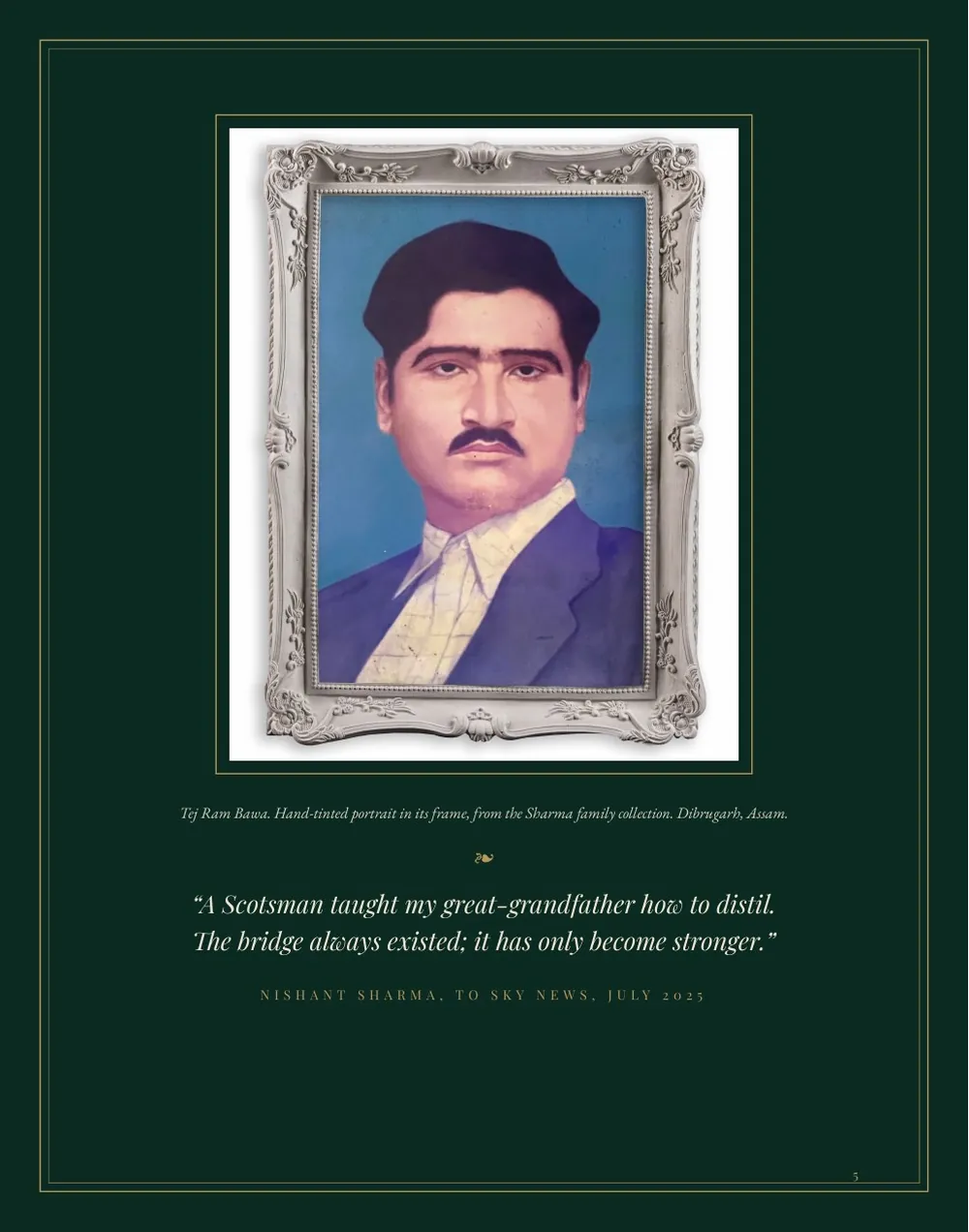
Caption: Tej Ram Bawa. Hand-tinted portrait in its frame, from the Sharma family collection. Dibrugarh, Assam. Quotation: “A Scotsman taught my great-grandfather how to distil. The bridge always existed; it has only become stronger.” Nishant Sharma, to Sky News, July 2025.
Part I opens
Part I. Where the story began. Assam, and a family memory. Page 7.
The first page of Part I
Dibrugarh sits on the south bank of the Brahmaputra in the far north-east of India, a river town that the tea trade made into one of the great gardens of the world. Its hills are corrugated with bushes; its mornings arrive in mist. In the 1940s it was a frontier: planters, clerks, labourers brought from across the subcontinent, and the officers who ran them. Tej Ram Bawa arrived from Punjab. The family remembers him working first in the forest department and then as a translator, standing between the British and the workers on the estates — a position of trust in both directions. It introduced him to a Scottish army officer who shared a private enthusiasm: spirits, and the making of them. The two men began to blend. Single malt was an officer’s privilege, not something a local man could buy, so Tej Ram bought it from the British and layered it with local whisky, adjusting sweetness and spice until it suited an Indian table. What they made they called Indian blended scotch, and they sold it quietly, outside the law. ❦ A craft, a name, and a story told at the table. ❦ The family dates the beginning to 1940. The enterprise was at its peak when the British left India in 1947, and the changes to the licensing laws that followed forced him to shut his doors; what remained was carried on quietly until 1985, when government regulation halted it altogether. What came down the generations was a craft, a name, and a story told at the table until it reached a great-grandson who had, by then, made his own home in the Scotsman’s country. This account is family oral history, as told by Nishant’s grandfather and recounted by Nishant.